# Path loss constant and RSSI distribution
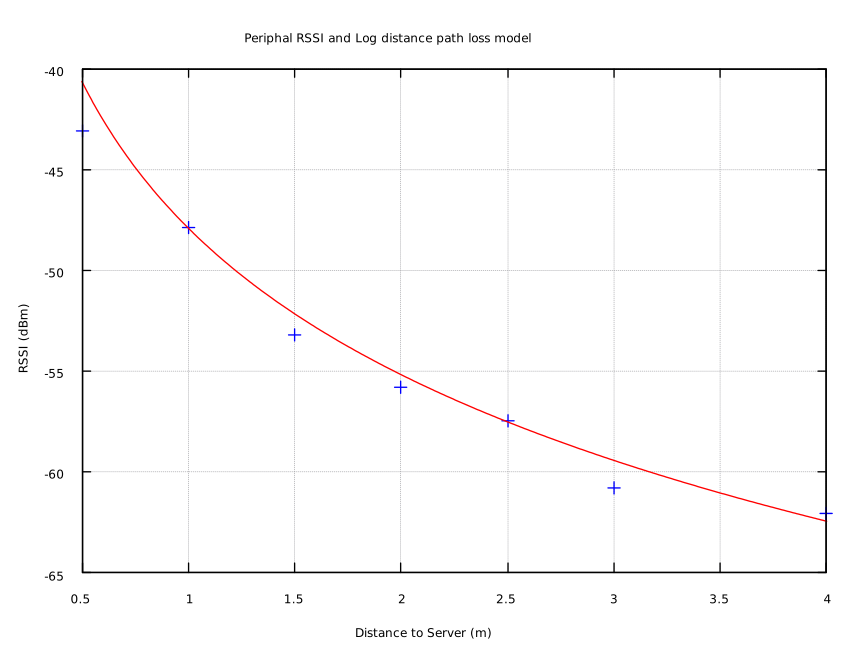
# Path loss model
The power loss of a signal is a function of the distance.
The measurement data is available at https://gitlab.com/mark-matura/ble-ips-files/-/tree/master/RSSI_measurements/05-10_path_loss_parameters.
# Average RSSI at varying
| Distance (m) | 0.5 | 1 | 1.5 | 2 | 2.5 | 3 | 4 |
|---|---|---|---|---|---|---|---|
| Average RSSI (dBm) | -43.092 | -47.916 | -53.212 | -55.812 | -57.476 | -60.776 | -62.036 |
| Standard Deviation RSSI (dBm) | 1.47657 | 3.741247 | 2.3317 | 2.25321 | 1.689034 | 1.778335 | 1.705973 |
The standard deviation is not bad for the averages but is subject to larger fluctuations with certain devices.
# Least squares based regression
I ran these numbers through GnuPlot to pass the data through some linear regression.
degrees of freedom    (FIT_NDF)                        : 6
rms of residuals      (FIT_STDFIT) = sqrt(WSSR/ndf)    : 1.25371
variance of residuals (reduced chisquare) = WSSR/ndf   : 1.57178

Final set of parameters            Asymptotic Standard Error
=======================            ==========================
n               = 2.41514          +/- 0.1279       (5.296%)
According to GPL the signal propagation exponent of my living room is
According to Wikipedia it is comparable to an office with a soft partition at a signal frequency of 1.9GHz.
Curve fit of
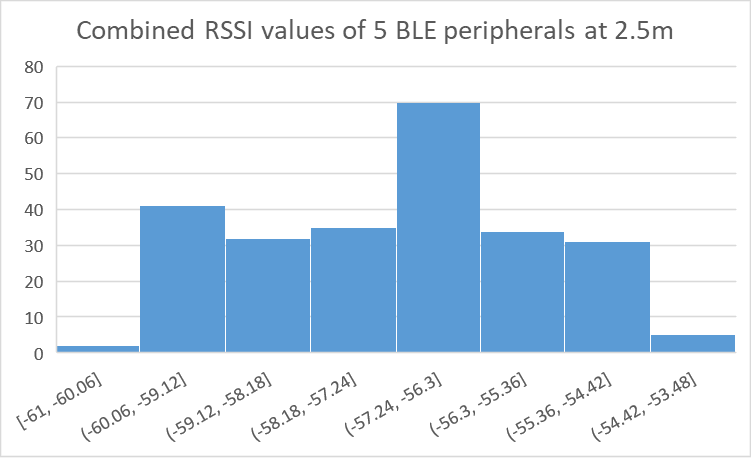
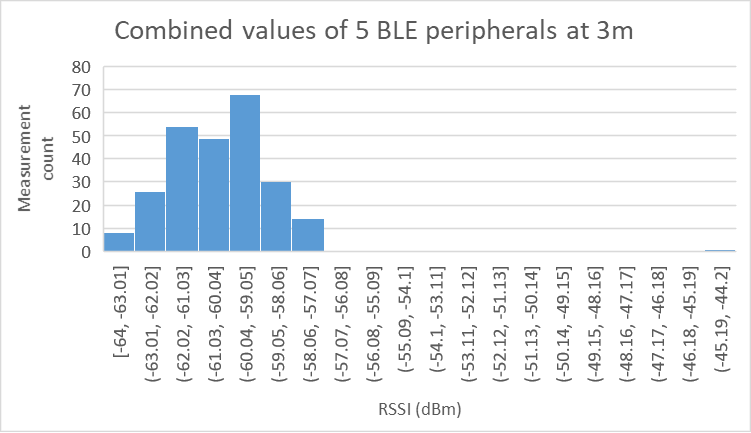
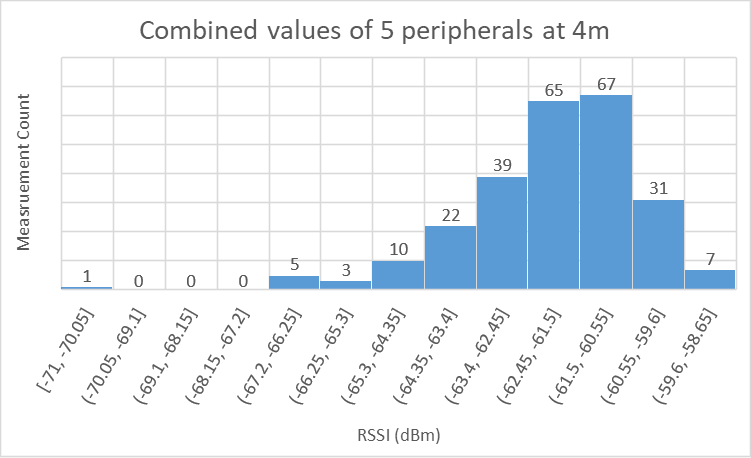
# Distribution of RSSI measurements (Histograms)
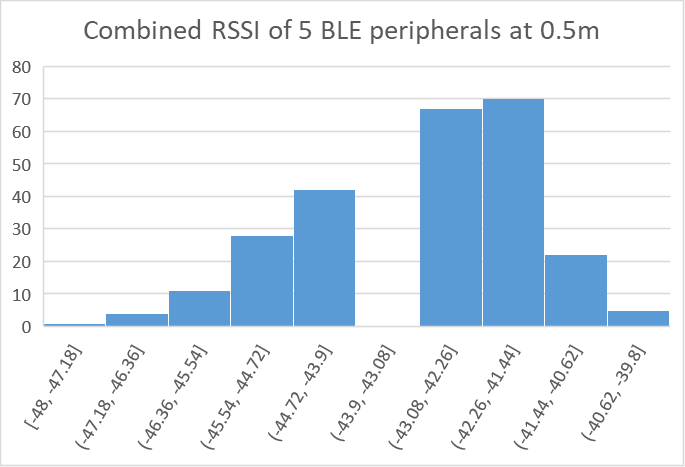
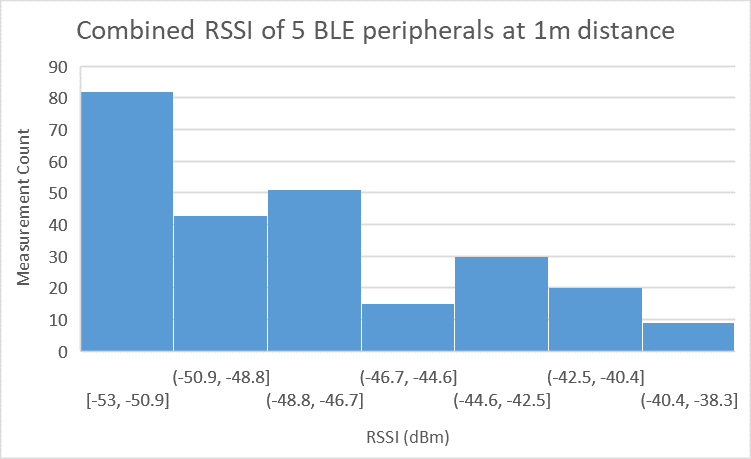
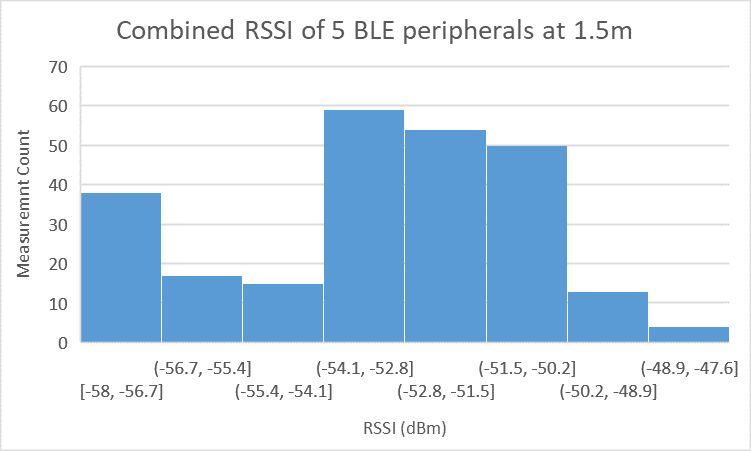
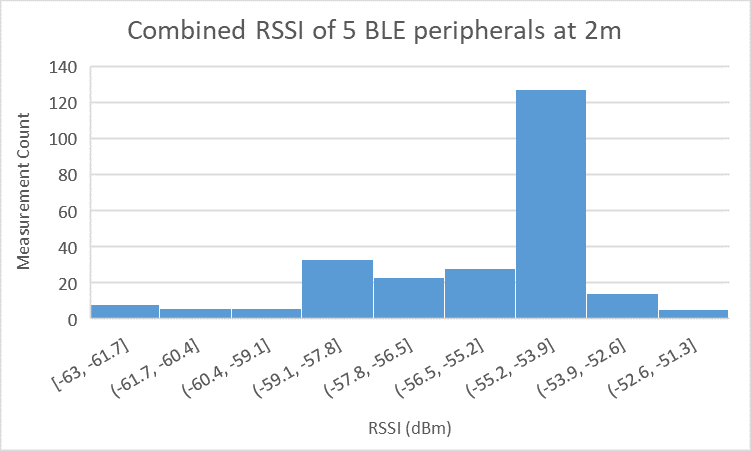
The distributions seem to be of gaussian form. That is nice, since the kalman filters described in 05-10 noise reduction are valid.